Adjustable Prosthetic Sockets - Are They Worth It?

As a prosthetic industry, we have embraced the idea of adjustable sockets. Technologies from companies such as Click Medical, Martin Bionics, and, formerly, Limb Innovations aim to make it easier for patients to manage the volume changes that are a necessary part of daily life.
Our bodies are always changing. We can see it in something as simple as how a watch fits around the wrist. Temperature changes, a high-sodium meal, diabetes, kidney disease, physical activity, and sports can all affect limb volume throughout the day. The best ways to promote volume stability are to maintain a consistent weight and diet and, when appropriate, use a suction-based suspension system. However, suction is not indicated for everyone. That is where adjustable sockets are intended to help.
Brief History of Adjustable Designs
In many ways, our industry started with adjustable sockets. Early sockets were held together with leather and lacing, and they could be tightened throughout the day, much like shoes. Over time, however, we learned that many people struggled with too much movement inside those systems. Frame-style socket designs gave the muscles something stable to push against and provided a more secure sense of fit. Over time, we have also reduced frame size and introduced more flexibility through flexible inner sockets. These designs have also helped stabilize volume to some degree, although they did not eliminate the fundamental reality that the body changes volume throughout the day.
Enter the prosthetic sock, arguably the ultimate form of socket adjustability. Socks can be effective, but they are not always easy. They require patients to understand their own volume patterns and to know when to add or remove layers. That process takes time, attention, and experience. The prosthetic sock, while designed to wick moisture away, can also make the socket feel warmer. These are the realities of their use, both good and frustrating.
Personal Practice Experience
In our practice, we have found that many patients do not perform as well with these new heavily marketed flexible designs. We have made our own adjustable designs. We have worked with adjustable technologies introduced by others, including serving as beta testers for Limb Innovations, and we have tried to approach each system with an open mind. We have found some straps/systems break easily and often at the least opportune times to the user. We have found that users regularly complain about the bulkiness of the designs.
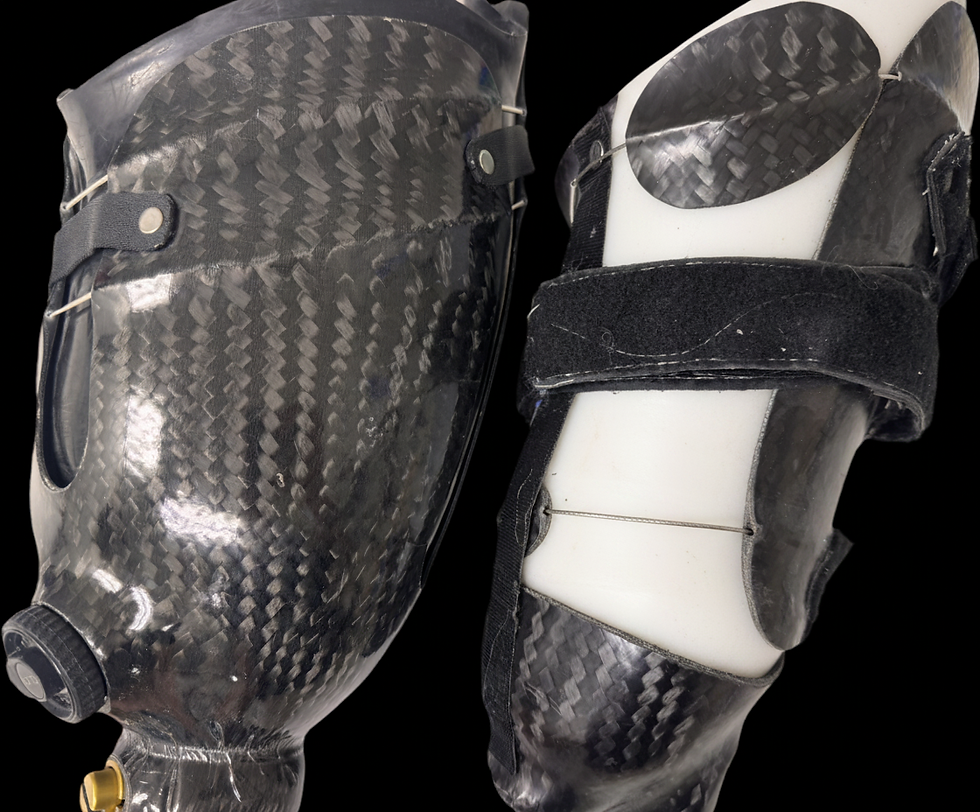
One experience stands out. A very active patient with a transtibial amputation came to us specifically requesting a Martin Bionics socket. We agreed to try it. We consulted directly with Martin Bionics, used FaceTime during the fitting process, and gave the system a fair opportunity. The patient returned miserable. He reported that the socket tore his pants, required constant adjustment, and never gave him a sense of security. At his request, we made him a new carbon-fiber socket with a pin suspension system. He loved it, felt secure, and never wanted to change systems again.
We have seen similar outcomes with other adjustable systems. Some users felt they lost their “home base” and struggled to find that secure, consistent fit again after making adjustments. In our experience, every patient who has tried an adjustable socket has ultimately returned to a more traditional frame-style socket. They may need to manage socks again, but they have decided it is an easier solution. One user saw the "Sling Shot" Trans Femoral design at the recent ACA conference. Her comment to me was that she thought it would only make her focus on the limb more, constantly adjusting and worrying that she did not have it on correctly. Instead she wants to focus less on her limb, but instead on the world around her.
Literature Review
A recent study showed that traditional sockets and adjustable sockets seem to have no difference in balance or fall prevention.¹ While that is encouraging at first glance, we also found that there have been very few studies on the overall fitness, step counts, and endurance that patients experience with a flexible design. Those done, include only a small study size (less than 5) and focus more on the 2MWT versus longer endurance functional tests available. In another study looking at socket comfort and quality of life, "participants abandoned a large number of sockets during the acclimation period due to discomfort or instability."² On that note, another literature review specifically notes the lack of evidence linking design to function, not to mention the lack of safety analysis, stating: "many adjustable sockets lack appropriate safety features to limit over- or under-tightening, which may present a risk of tissue damage or provide inadequate coupling, affecting function and satisfaction. Furthermore, the relationship between design and comfort or function are rarely investigated and remains a significant gap in the literature."³
Concluding Thoughts
Are we cynical about parts of our own profession? At times, yes. We worry that adjustable sockets can be marketed as a universal solution when, for many patients, they may create new frustrations. We will certainly continue to provide an adjustable socket when it is clinically appropriate and when that is what a patient really wants. We are very open to new ideas and innovation in this field. So are adjustable prosthetic sockets worth it? We tend to thing they are oversold and based on our experience, we believe the technology can sometimes feel like a step backward rather than a meaningful advance. We write this article in consideration of the questions we get when considering these systems.
Gates DH, Wensman J, Gutierrez AR, et al. Effects of adjustable-volume transfemoral prosthetic sockets on balance and falls: A randomized clinical trial. PM&R. 2026; 1-11. doi:10.1002/pmrj.70183
Gates DH, Wensman J, Gutierrez AR, Kartes J, Avalos MA, Rosenblatt NJ. Effect of Transfemoral Adjustable-Volume Sockets on Socket Comfort and Quality of Life: A Randomized Controlled Trial. Arch Phys Med Rehabil. 2026 Feb;107(2):169-177. doi: 10.1016/j.apmr.2025.08.018. Epub 2025 Sep 6. PMID: 40921317.
Baldock M, Pickard N, Prince M, Kirkwood S, Chadwell A, Howard D, Dickinson A, Kenney L, Gill N, Curtin S. Adjustable prosthetic sockets: a systematic review of industrial and research design characteristics and their justifications. J Neuroeng Rehabil. 2023 Nov 6;20(1):147. doi: 10.1186/s12984-023-01270-0. PMID: 37926807; PMCID: PMC10626671.

Comments